The greatest risk of AI adoption may not be biased AI. It may be organizations operationalizing bias at scale without realizing it.
When we talk about AI bias, the usual question is:
Is the AI model biased?
Perhaps we should ask a slightly different question:
What are we asking AI to operationalize?
AI learns from data; data reflects history, and the history reflects human decisions, policies, incentives, and assumptions.
AI may not create those assumptions, but it can automate them at scale.
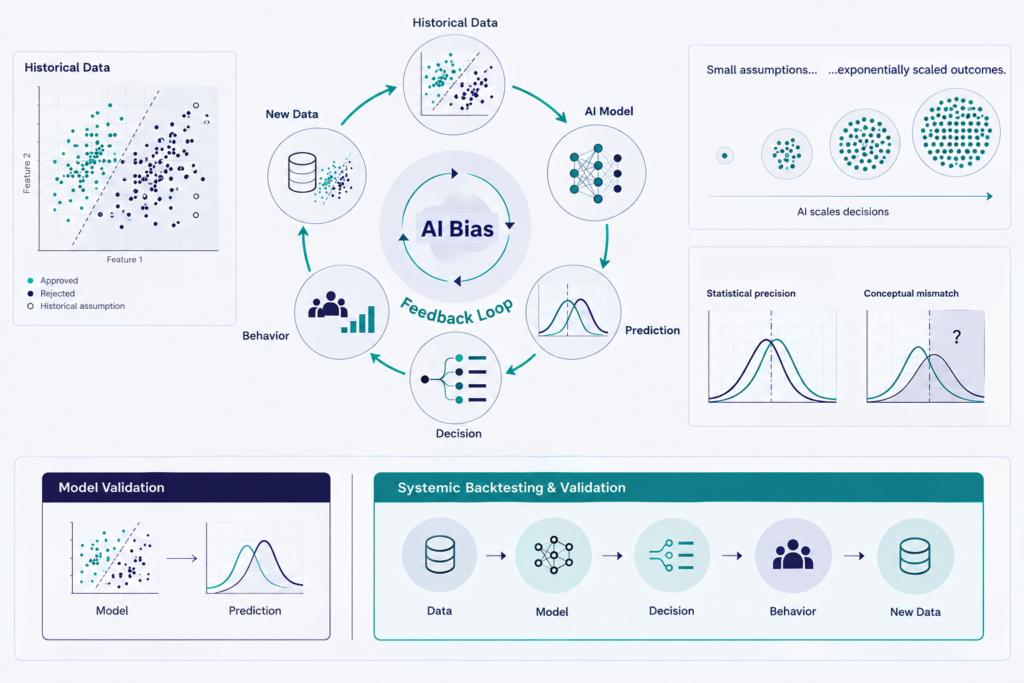
How AI Models Learn from Historical Data
Consider a credit risk model trained on historical approvals and defaults. The model learns who defaulted. But the historical portfolio was itself shaped by previous underwriting decisions. Applicants who were rejected never generated observed repayment outcomes.
So what exactly did the model learn?
It learned patterns within a historically selected population.
Such a model may be highly predictive while still inheriting limitations from the process that produced its training data.
AI can learn the pattern without understanding why it exists.
That distinction matters far beyond credit risk. The same dynamic exists in hiring, fraud detection, marketing, insurance, customer scoring, lead generation, and pricing.
AI-driven Automation Alters the Risk Profile
A human decision affects a limited number of people.
An AI system can apply the same logic to millions.
That is the power of AI. It is also where the risk profile of AI adoption changes.
A small assumption embedded in historical data can become a large-scale operational outcome. Because the outcome comes from an AI model, it can appear objective, but mathematical precision does not make an underlying assumption correct.
A model can be statistically precise while being conceptually wrong.
This is why AI model validation cannot be separated from understanding the business process in which the model operates.
Is the Bias Really in the AI Algorithm?
Bias can enter long before the algorithm:
Business Question → Data → Labels → Features → Model → Threshold → Decision
Who defined the outcome?
Who was represented in the data?
Who was missing?
What decisions shaped the historical outcomes?
What happens when an AI prediction becomes a business decision?
These are not merely data science questions.
They are AI adoption and AI governance questions.
A model can perform well on historical data while the broader decision system remains poorly understood.
That is why organizations should evaluate not only the model performance but also the assumptions and processes surrounding the model.
Can AI Learn From Its Own Decisions?
Consider the cycle:
Data → AI → Decision → Behavior → New Data → AI
If today’s AI decisions change customer behavior, those outcomes may become tomorrow’s training data.
The system begins learning from consequences it helped create.
At this point, bias is no longer simply something inside an AI model.
It becomes part of the data structure and decision ecosystem.
This is where systemic backtesting and validation become important.
Testing whether a model predicts historical outcomes accurately is only one part of validation. Organizations should also ask:
What happens when the model interacts with the real decision process?
Why Systemic Backtesting and Validation Matter
Traditional model validation often focuses on whether the model performs well against historical or holdout data. That is necessary.
But for AI systems embedded in business decisions, it may not be sufficient. Systemic validation asks a broader question:
Does the entire decision system behave as expected when the model is introduced into it?
That means looking beyond the model itself and considering:
- the data-generating process
- historical selection effects
- model predictions
- decision thresholds
- business rules
- downstream actions
- customer behavior
- changing populations
- feedback loops
The objective is not simply to determine whether an AI model is accurate.
It is to understand what happens when that model becomes part of the operating system of the business.
Before We Deploy AI Models, What Should We Understand?
The question for organizations should not simply be:
Can we automate this decision?
It should be:
Do we understand this decision well enough to automate it?
And perhaps the most important question is:
What assumptions are we forcing AI to operationalize?
Because AI does not need to create bias to scale it.
It only needs us to stop questioning where the pattern came from.
AI can scale intelligence. It can also scale what we fail to understand.